


The site-of-care shift is real money moving out of hospitals and into ambulatory surgery centers and office-based labs. Whether a practice captures it comes down to one thing: knowing its numbers.
Healthcare reimbursement is moving again, and this time the momentum is clearly leaving the hospital campus.
In our own backyard, Independence Blue Cross turned on a new policy June 1, and Highmark did the same January 1. Both target the same setup: a low-risk patient, a routine procedure, and a commercial or Medicare Advantage plan.
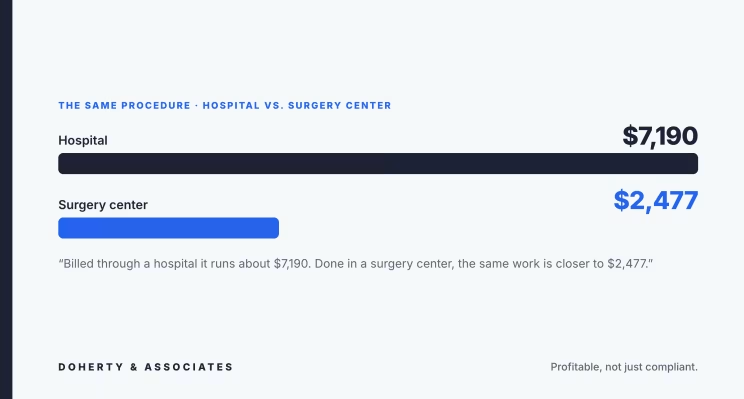
In that case, the insurer now points the case away from the hospital outpatient department and toward an ambulatory surgery center (ASC) or another lower-cost site. IBX’s chief operating officer, Richard Snyder, called it “a gentle move,” not a mandate. But the direction is not subtle. Take a knee cartilage removal. Billed through a hospital it runs about $7,190. Done in a surgery center, the same work is closer to $2,477.
When employer health costs jumped 6.7% this year, insurers stopped admiring that gap and started acting on it.
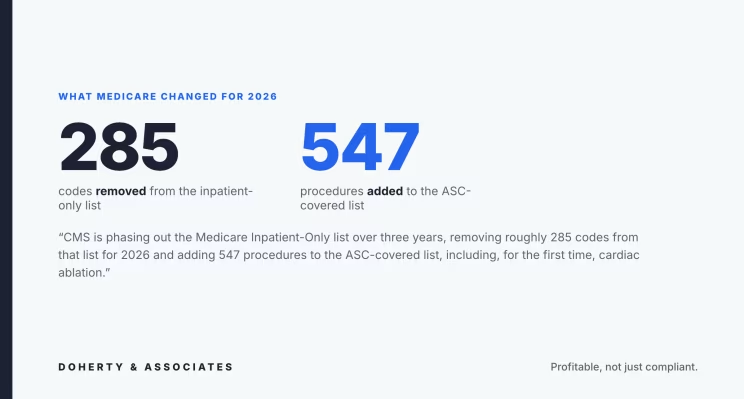
Washington is pushing the same way. CMS is phasing out the Medicare Inpatient-Only list over three years, removing roughly 285 codes from that list for 2026 and adding 547 procedures to the ASC-covered list, including, for the first time, cardiac ablation. Office-based labs got a raise too: the 2026 physician fee schedule moves reimbursement toward office-based cardiovascular work, roughly 5 percent up in the office and 6 percent down in the facility. Stack up the orthopedic volume now cleared to move, and the dollars leaving hospital balance sheets run into the billions.
If you own a practice in orthopedics, cardiology, GI, or any procedural specialty, the headline reads like a gift. Here is the part the trade press keeps skipping: this is not a clinical story. It is an owner story.
The upside is real. But great surgeons lose money on bad business models every day.
The real prize here is not your professional fee. It is the facility payment, the money that used to flow to the hospital for the room, the staff, and the equipment, which can now flow to your ownership structure instead of the hospital’s. That is not a credentialing exercise. It is a business line, and it has to pencil. A few things we tell owners before they chase it:
Know your true cost per case before you fall in love with the top line
An ASC is cheaper than a hospital for structural reasons, not because the surgeon is any different. If you do not know your fully loaded cost to perform a given procedure in your own four walls, including staff time, supplies, room turnover, and financing, you do not know whether you are building profit or doing discounted work for your payer. Most practice owners cannot produce that number without digging, guessing, or calling three people. That is the readiness gap.
Do the napkin math before you do the buildout
Take that knee cartilage example again. Hospital outpatient, about $7,190. Surgery center, about $2,477. That spread is why the payer is moving the case. Your question is a different one. If your net facility reimbursement is $2,477 and your true cost per case is $2,050, you have a business with a real margin. If your true cost is $2,600 once you count staffing, supplies, anesthesia, financing, billing, and downtime, you are doing that surgery at a loss, and more volume just deepens the hole. Bad unit economics do not fix themselves at scale. They compound.
Structure it before you build it
How you own the ASC or OBL, and whether the real estate sits in a separate entity you also own, decides how much of this new margin you actually keep. The winners will not be the doctors who add a room and hope the margin shows up. They are the ones who set up the ownership, the real estate, and the payer contracts, with the right tax and legal guidance, so the facility income does not leak out through bad structure, bad leases, or bad contracts.
This changes what your practice is worth
A practice that captures facility revenue is a different asset than one that refers those cases away. It carries a higher, more diversified EBITDA, and that is exactly the kind of profile buyers value. If an exit is anywhere in your five-year plan, the site-of-care shift is not just an income question. It is a valuation question.
Underwrite the downside, because the arbitrage may not last
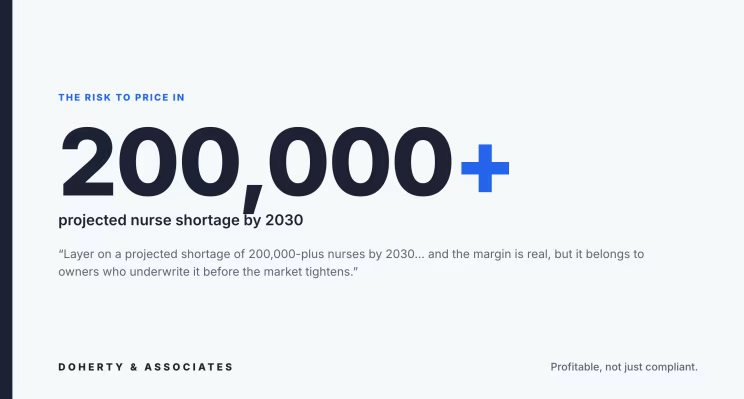
The same site-neutral logic that is moving cases to you today can compress the facility premium tomorrow. Layer on a projected shortage of 200,000-plus nurses by 2030, the new Medicare WISeR AI prior-authorization pilot rolling out in six states in 2026, and rising staffing and anesthesia costs, and the margin is real, but it belongs to owners who underwrite it before the market tightens. Build the model on conservative rates, not this year’s best-case ones.
This is already a local fight
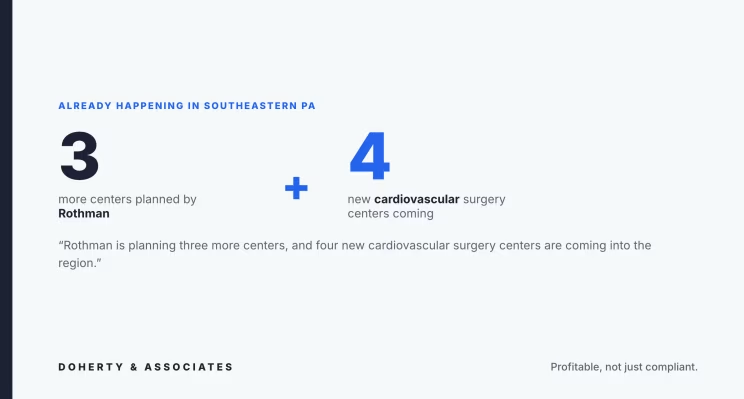
None of this is theoretical in southeastern Pennsylvania. Rothman is planning three more centers, and four new cardiovascular surgery centers are coming into the region. That tells you where the serious operators think the volume is going. If you wait until the payers, the hospitals, and the better-capitalized groups have locked up the sites, the staff, the contracts, and the referral patterns, you can still be clinically excellent. You will just be negotiating from the cheap seats.
The insurers are not asking whether the care can move. They have decided it can. The question is who has the numbers, the structure, and the nerve to catch it profitably.
That is the whole game, and it is the same standard we hold every client to: profitable, not just compliant. The shift will pay owners who know their numbers and punish the ones who confuse volume with profit.
What we look at first
Before an owner signs a lease or buys a single piece of equipment, we want three numbers on one page: expected cases by CPT code, fully loaded cost per case, and expected net reimbursement by payer. Then we look at who owns what.
Does the practice capture the facility income?
Does a separate entity own the building?
Are the partners aligned, or did someone plant a future dispute with a spreadsheet that looked clean for one afternoon?
The medicine can be excellent and the deal can still be wrong.
If you are weighing an ASC or OBL move, three questions are worth answering before you spend a dollar:
What is your real cost per case today?
Who owns the facility and the building, and does the structure keep the margin?
And what does adding this revenue line do to your practice’s value in a sale?
Get those right, and the site-of-care shift stops being a headline and starts being a raise.
Sources
- Philadelphia Inquirer, “IBX and Highmark want to cut costs by moving more outpatient care to surgery centers” (June 14, 2026).
- Centers for Medicare & Medicaid Services, CY 2026 OPPS/ASC Final Rule (McDermott+Consulting summary).
- Ambulatory Surgery Center News, “IPO List Phaseout Sets Stage for Multibillion-Dollar Shift to Surgery Centers”.
- Cardiovascular Business, “Office-based interventional labs see boost in pay in 2026”.
- Modular Devices, “How 2026 CMS Reimbursement Changes Are Accelerating Cardiovascular Growth in ASCs”.
- Regent Surgical, “Executive Outlook: Why 2026 Could Redefine the ASC Business Model”.

